How Edge Networking can Save You Time, Stress, and Money.
Table of ContentsThe Basic Principles Of Edge Networking The 6-Second Trick For Edge NetworkingEdge Networking for DummiesSome Known Details About Edge Networking The 45-Second Trick For Edge Networking
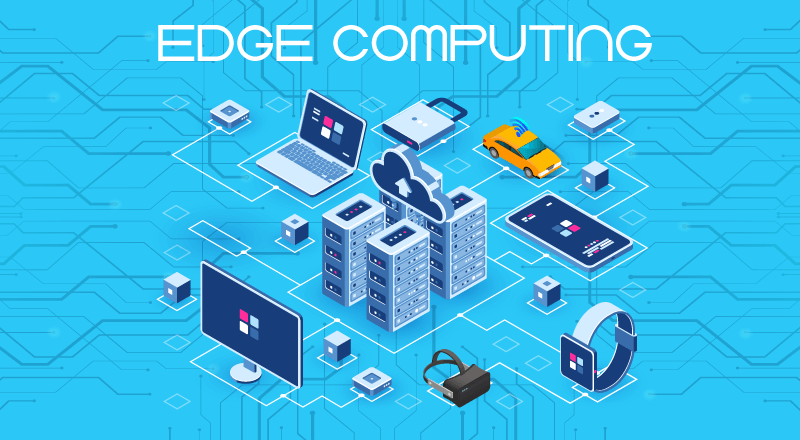
The increase of IoT gadgets at the edge of the network is producing an enormous amount of information to be computed at information centers, pushing network bandwidth requirements to the limit. In spite of the enhancements of network technology, information centers can not guarantee acceptable transfer rates and response times, which could be a critical requirement for numerous applications.In a similar way, the objective of Edge Computing is to move the computation away from data centers towards the edge of the network, exploiting clever items, mobile phones or network gateways to carry out tasks and supply services on behalf of the cloud. By moving services to the edge, it is possible to supply content caching, service delivery, storage and IoT management resulting in better response times and transfer rates.
The dispersed nature of this paradigm introduces a shift in security schemes used in cloud computing. In edge computing, data might take a trip in between various dispersed nodes linked through the Internet, and hence requires unique file encryption systems independent of the cloud. Edge nodes might also be resource constrained devices, restricting the choice in regards to security methods.
On the other hand, by keeping information at the edge it is possible to move ownership of gathered data from provider to end-users. Scalability in a dispersed network needs to face various issues. First, it should consider the heterogeneity of the gadgets, having various performance and energy restraints, the highly dynamic condition and the reliability of the connections, compared to more robust infrastructure of cloud data centers.
The Greatest Guide To Edge Networking
Management of failovers is important in order to keep a service alive. If a single node decreases and is inaccessible, users should still be able to access a service without interruptions. Furthermore, edge computing systems need to offer actions to recover from a failure and notifying the user about the event.
Other aspects that might affect this aspect are the connection innovation in usage, which may offer various levels of reliability, and the precision of the data produced at the edge that could be undependable due to specific environment conditions. Edge computing brings analytical computational resources close to the end users and therefore helps to speed up the communication speed.
Some applications count on short response times making edge computing a substantially more feasible option than cloud computing. Examples are applications involving human perception such as facial recognition, which usually takes a human in between 370-620ms to perform. Edge computing is more most likely to be able to imitate the same perception speed as human beings, which works in applications such as enhanced reality where the headset need to preferably recognize who an individual is at the same time as the wearer does.
This positioning at the edge assists to increase functional efficiency and contributes many advantages to the system (Edge Networking). In continue reading this addition, the usage of edge computing as an intermediate stage between client gadgets and the larger internet results in effectiveness savings that can be demonstrated in the copying: A client device needs computationally intensive processing on video files to be performed on external servers.
Not known Details About Edge Networking
Preventing transmission over the internet leads to considerable bandwidth cost savings and therefore increases efficiency. Edge application services minimize the volumes of data that need to be moved, the following traffic, and the distance that information need to take a trip. That supplies lower latency and decreases transmission expenses. Calculation unloading for real-time applications, such as facial acknowledgment algorithms, showed considerable enhancements in response times, as shown in early research study.
On the other hand, offloading every job may lead to a downturn due to transfer times in between device and nodes, so depending on the work an ideal setup can be specified. Another use of the architecture is cloud gaming, where some elements of a game might run in the cloud, while the rendered video is transferred to lightweight customers running on devices such as mobile phones, VR glasses, etc.
( 2010 ). " The Akamai Network: A Platform for High-Performance Web Applications" (PDF). ACM SIGOPS Platforms Evaluation. 44 (3 ): 219. doi:10. 1145/1842733. 1842736. S2CID 207181702. Archived (PDF) from the original on September 13, 2012. Recovered November 19, 2012. See Area 6. 2: Dispersing Applications to the Edge Davis, A.; Parikh, J.; Weihl, W.
The Of Edge Networking
" EdgeComputing: Extending Enterprise Applications to the Edge of the Web". 13th International World Wide Web Conference. doi:10. 1145/1013367. 1013397. S2CID 578337. " ETSI - ETSI Blog Site - What is Edge?". etsi. org. Obtained 2019-02-19. " CloudHide: Towards Latency Concealing Strategies for Thin-client Cloud Video Gaming". ResearchGate. Obtained 2019-04-12. Anand, B.; Edwin, A. J.
" Gamelets Multiplayer mobile games with distributed micro-clouds". 2014 Seventh International Conference on Mobile Computing and Ubiquitous Networking (ICMU): check that 1420. doi:10. click this link 1109/ICMU.2014. 6799051. ISBN 978-1-4799-2231-4. S2CID 10374389. Ivkovic, Jovan (2016-07-11). " [Serbian] The Techniques and Procedures for Accelerating Operations and Queries in Large Database Systems and Data Warehouse (Big Data Systems)". Hgpu.
Shi, Weisong; Cao, Jie; Zhang, Quan; Li, Youhuizi; Xu, Lanyu (October 2016). "Edge Computing: Vision and Obstacles". IEEE Internet of Things Journal. 3 (5 ): 637646. doi:10. 1109/JIOT.2016. 2579198. S2CID 4237186. Merenda, Massimo; Porcaro, Carlo; Iero, Demetrio (29 April 2020). " Edge Device Learning for AI-Enabled IoT Gadgets: An Evaluation". Sensing units. 20 (9 ): 2533.
3390/s20092533. PMC. Edge Networking. PMID 32365645. Garcia Lopez, Pedro; Montresor, Alberto; Epema, Cock; Datta, Anwitaman; Higashino, Teruo; Iamnitchi, Adriana; Barcellos, Marinho; Felber, Pascal; Riviere, Etienne (30 September 2015). " Edge-centric Computing". ACM SIGCOMM Computer System Communication Review. 45 (5 ): 3742. doi:. Satyanarayanan, Mahadev (January 2017). " The Development of Edge Computing". Computer. 50 (1 ): 3039.
Edge Networking Fundamentals Explained
